

We welcome our community to use OpenGrid brand assets.
Brand Guidelines
Purpose
Grid planning is the bottleneck standing between energy demand and energy delivery. A single interconnection study can take five to fifteen years to move from plan to power, and if a developer drops out partway through, a restudy can force months of rework. Meanwhile, the volume of new electricity being added to grids worldwide is growing 57% a year. The tools doing the planning were mostly built for a thermal, centralized grid — not one where variable renewables are projected to nearly double their share of generation by 2030, or where only 5 to 10% of the people modeling the grid have access to the commercial software required to do it.
OpenGrid exists to close that gap. It is an open-source platform, a builder ecosystem, and a governance structure — hosted at the Linux Foundation — built around one premise: the tools and data needed to plan the grid should be shared infrastructure, not a proprietary bottleneck. Its foundation layer (open data, open standards, open APIs) lets any tool, commercial or open source, plug in and interoperate. Its application layer (solvers, orchestration, plugins, visualization) gives modelers, developers, and non-technical stakeholders a faster, more accessible way to actually do the work.
The name is not a metaphor — it’s a straightforward description. OpenGrid is open applied to the grid: open data instead of paywalled datasets, open standards instead of siloed formats, open governance instead of one vendor’s roadmap. It exists so that grid operators, developers, researchers, regulators, and funders can build on the same foundation instead of each rebuilding it alone.
OpenGrid’s stated vision is to accelerate a future of energy abundance — not by building one more modeling tool, but by building the shared plumbing underneath all of them, so infrastructure can scale at the pace the transition demands.
Brand Attributes
Foundation-first
OpenGrid doesn’t build another modeling tool to compete with the dozens already in use — it builds the data hub, schema, and APIs underneath them. Every attribute claim should trace back to this: interoperability over lock-in, shared plumbing over one more point solution.
Evidence-led
OpenGrid’s own copy never says “grid planning is broken” without a number attached — five to fifteen years, 57%, 5 to 10%, a near-doubling of VRE share by 2030. It models the same rigor it’s asking modelers to bring to their studies. Any brand-approved claim should be able to point to a driver, a dataset, or a number.
Neutral by governance
OpenGrid sits inside the Linux Foundation with a Management Committee, a Technical Committee, and an Observer track, specifically so no single funder, vendor, or utility steers the roadmap. Neutrality here is a structure, not a slogan — it’s a reason funders and competitors can both trust the same platform.
Builder-oriented
The primary calls to action are “Start contributing,” “Explore the datasets,” and “Get involved on GitHub” — not “book a demo.” OpenGrid talks to people who will use, extend, or fund the platform, not to a general audience being sold something.
Paced to urgency
Grid planning timelines are treated as the central problem, not a footnote. OpenGrid’s tone should carry the same sense of consequence without tipping into alarmism — speed is a design constraint, stated plainly, not a scare tactic.
Logo
The primary lockup — symbol and wordmark together — is OpenGrid’s default mark. Use it whenever there’s room for it. It should appear in full color on light backgrounds; switch to the black or white version only when the surface won’t support the primary palette.
When in doubt, default to this primary logo.

Logo Scaling
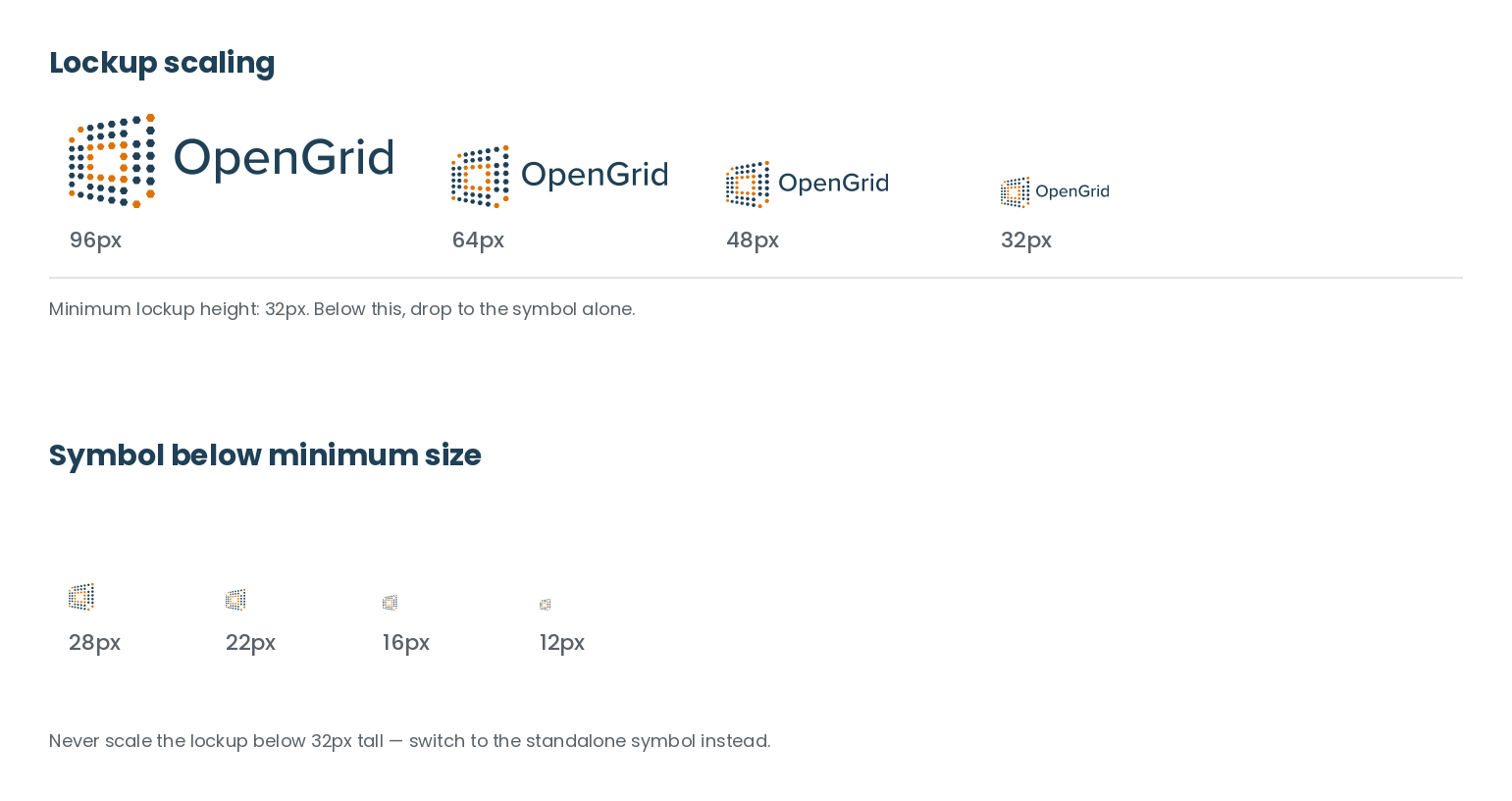
The lockup scales down to 32px tall and no smaller. Below that, the wordmark stops reading cleanly, so drop to the standalone symbol instead — it holds up at sizes the full lockup can’t.
Clearspace
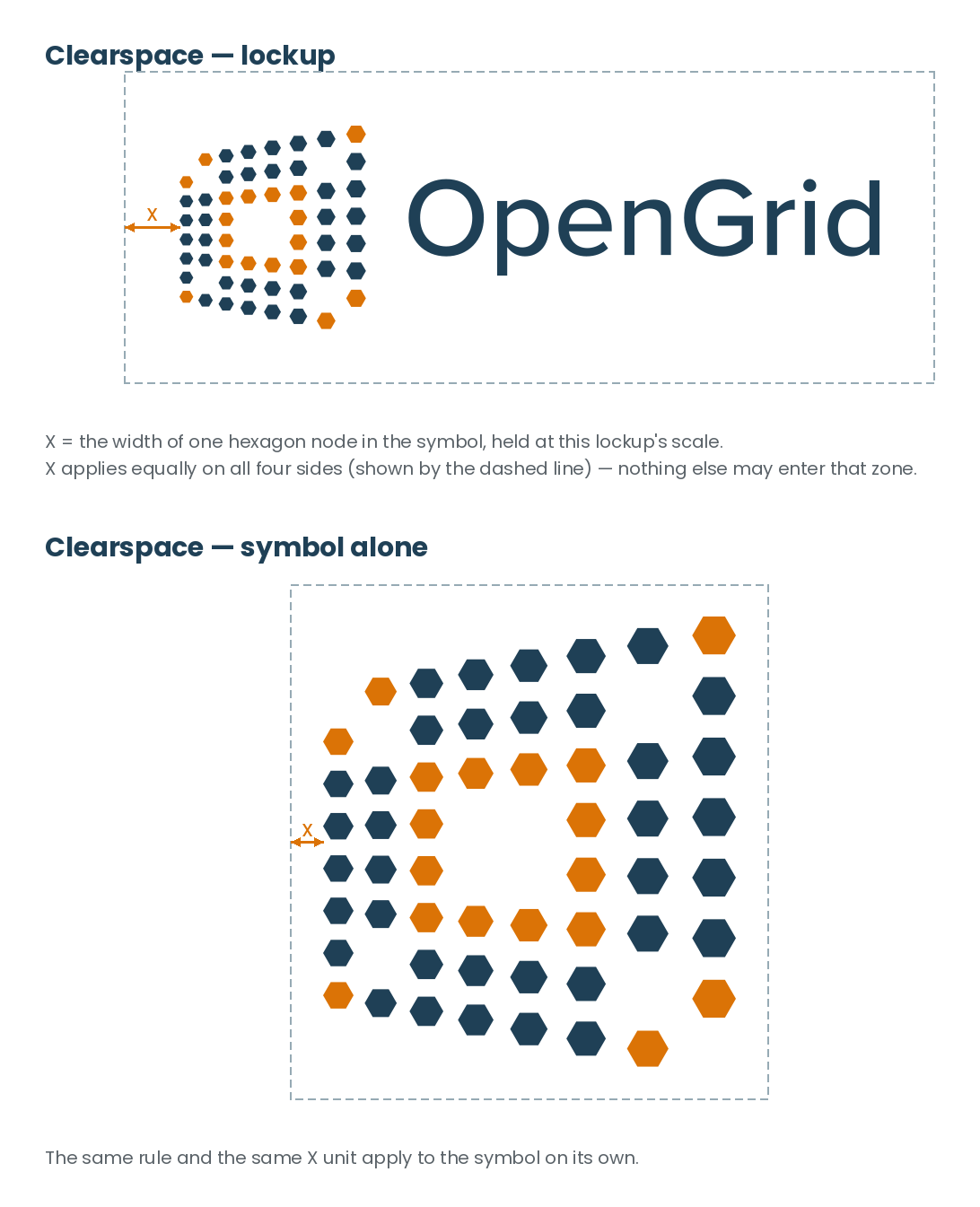
Keep clear space equal to X on every side of the mark, where X is the width of one hexagon node in the symbol itself — not an arbitrary margin. Nothing else, no text, edge, or other mark, enters that zone. The same X and the same rule apply whether it’s the full lockup or the symbol alone.
Partnership Lockups
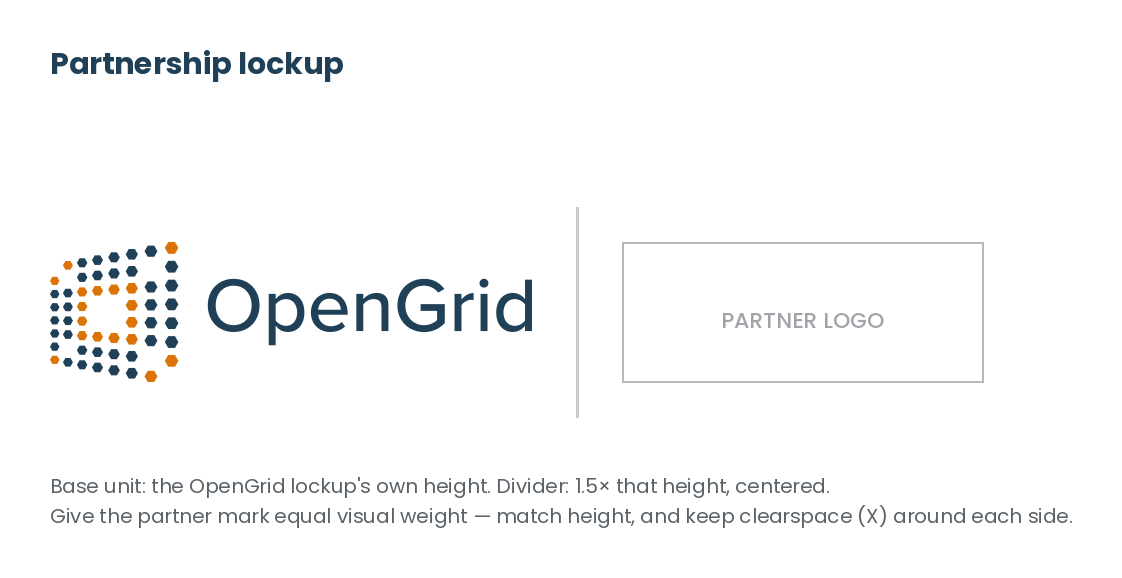
When OpenGrid appears next to a partner’s mark, the OpenGrid lockup’s own height sets the base unit. The divider between the two marks runs 1.5× that height, centered. Give the partner mark equal visual weight — match its height to OpenGrid’s, and keep clearspace around each side. A partner logo squeezed smaller than OpenGrid’s isn’t a partnership lockup, it’s a footer credit.
Watchouts
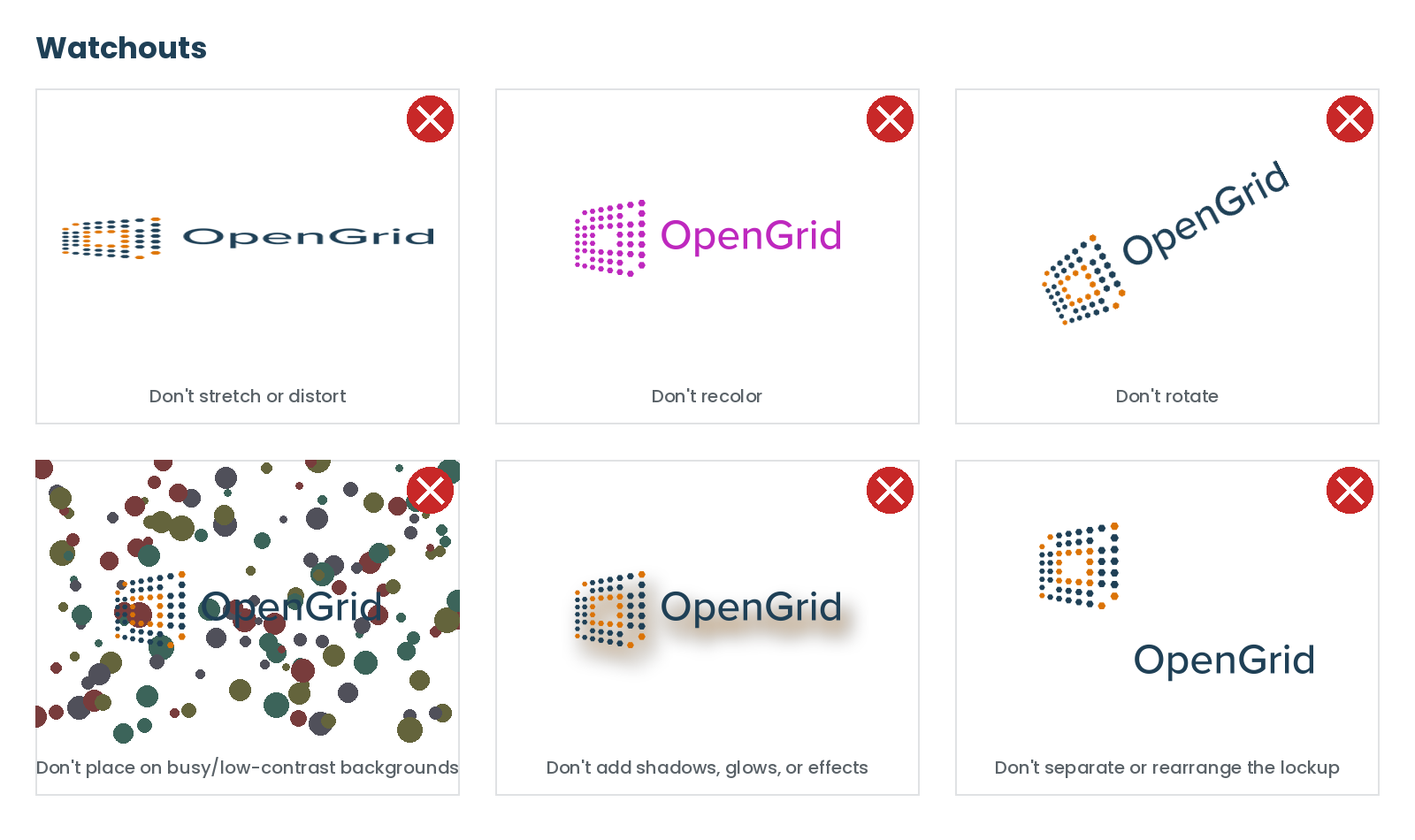
To preserve the integrity and effectiveness of our brand, it’s crucial to use our logo consistently and as intended. The following examples illustrate common misuses to avoid.
Symbol
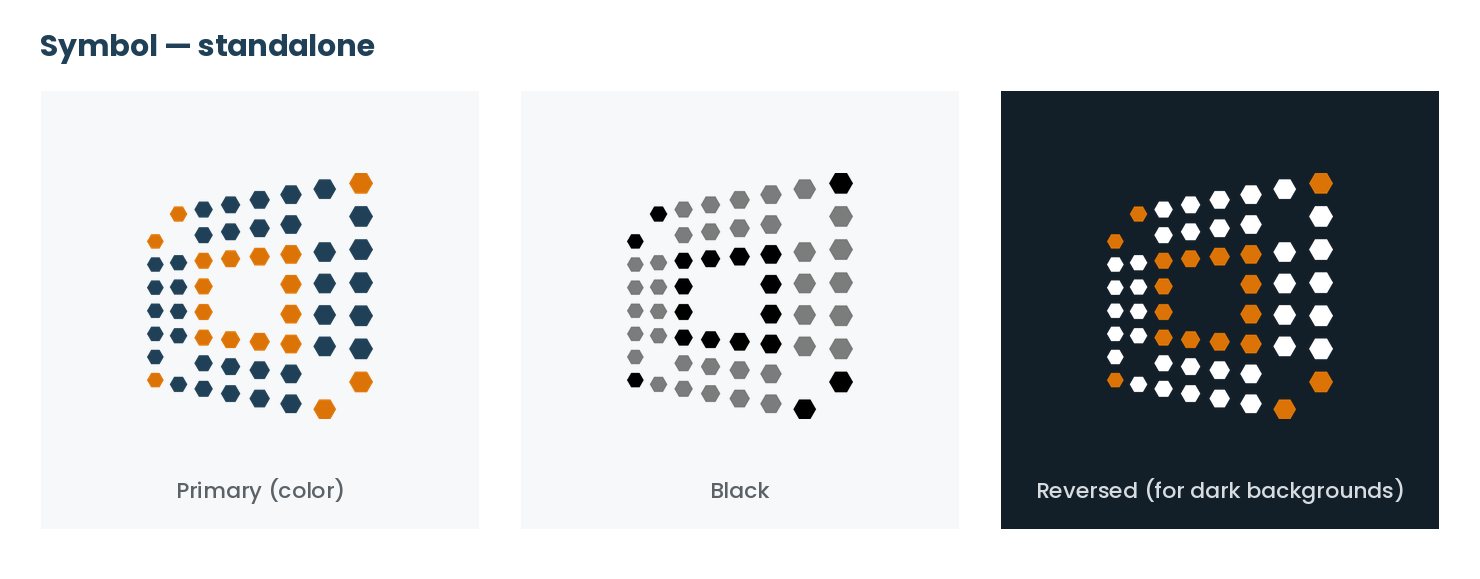
The symbol has three official exports — color, black, and white — and only those three. Each appears inside its own square container; the white version needs a dark or colored background to read at all, since it’s a cutout with no fill of its own.
Symbol in Shape
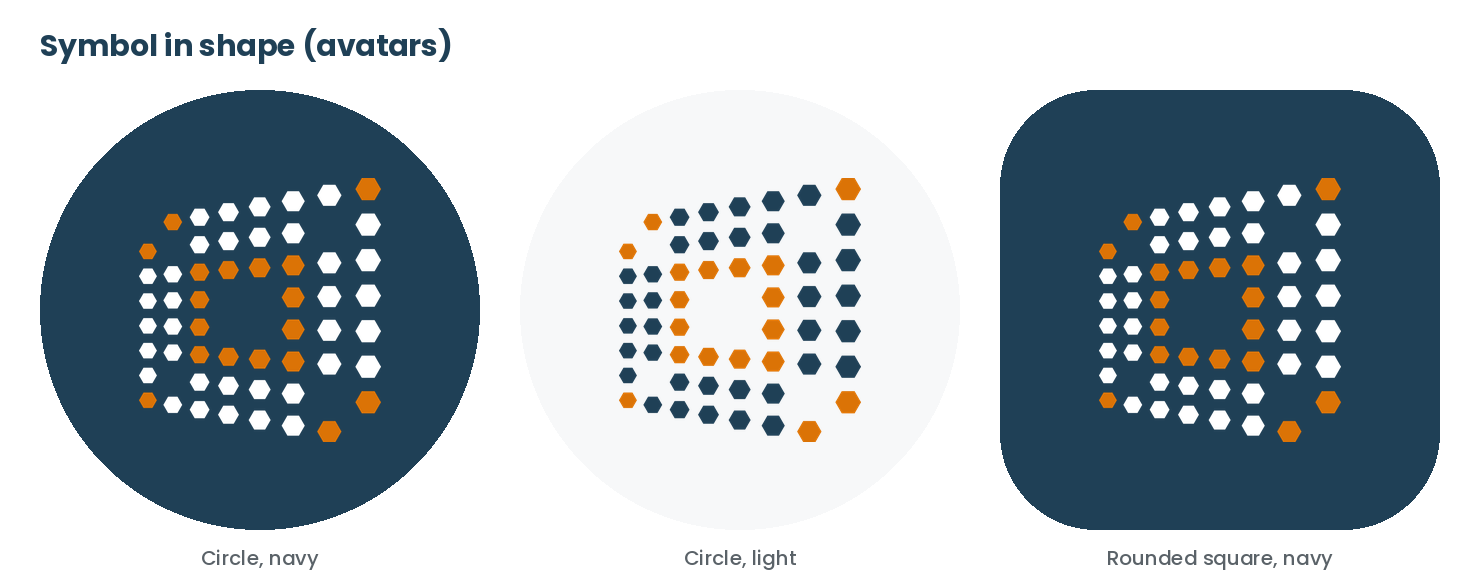
For avatars and app icons, the bare symbol — no square — can be composited into a circle or rounded square instead. This is the one place the symbol leaves its native container. Keep one clearspace unit between the glyph and the edge of whatever shape it’s placed in.
Primary Palette
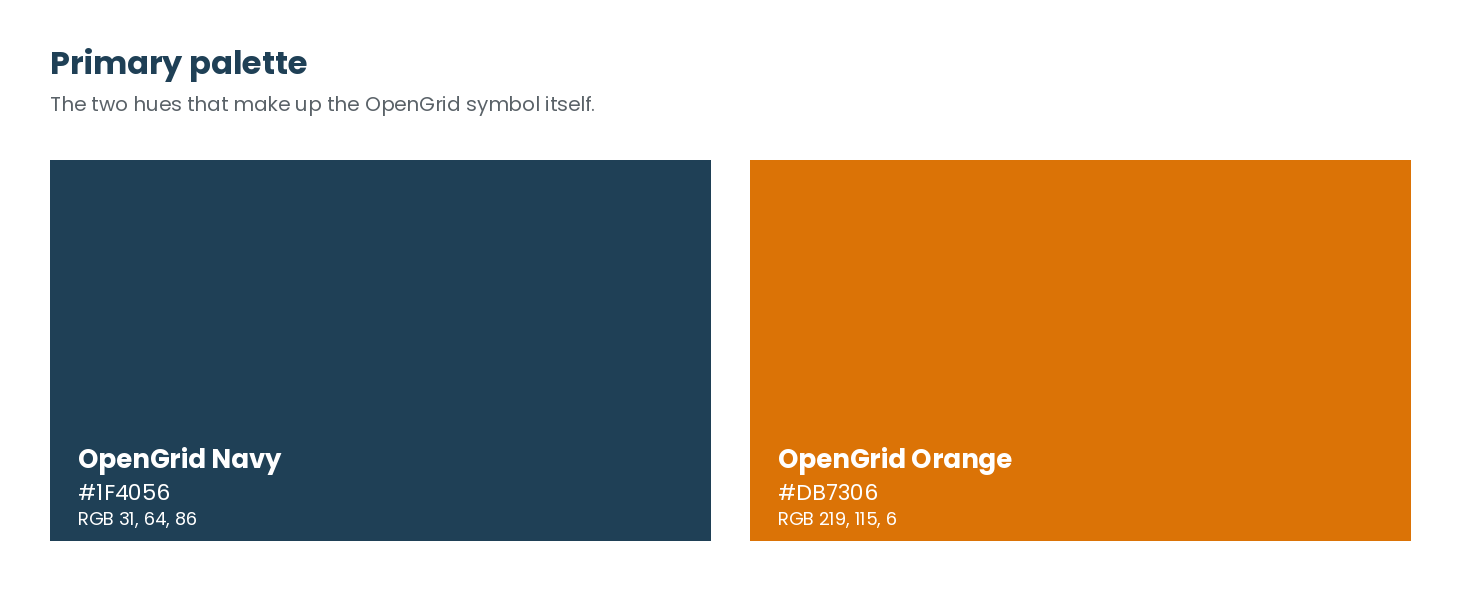
OpenGrid Navy and OpenGrid Orange are the two hues in the symbol itself, not a separately invented brand palette. Navy carries the weight; orange is the accent, used the way it’s used in the mark — sparingly.
Secondary Palette
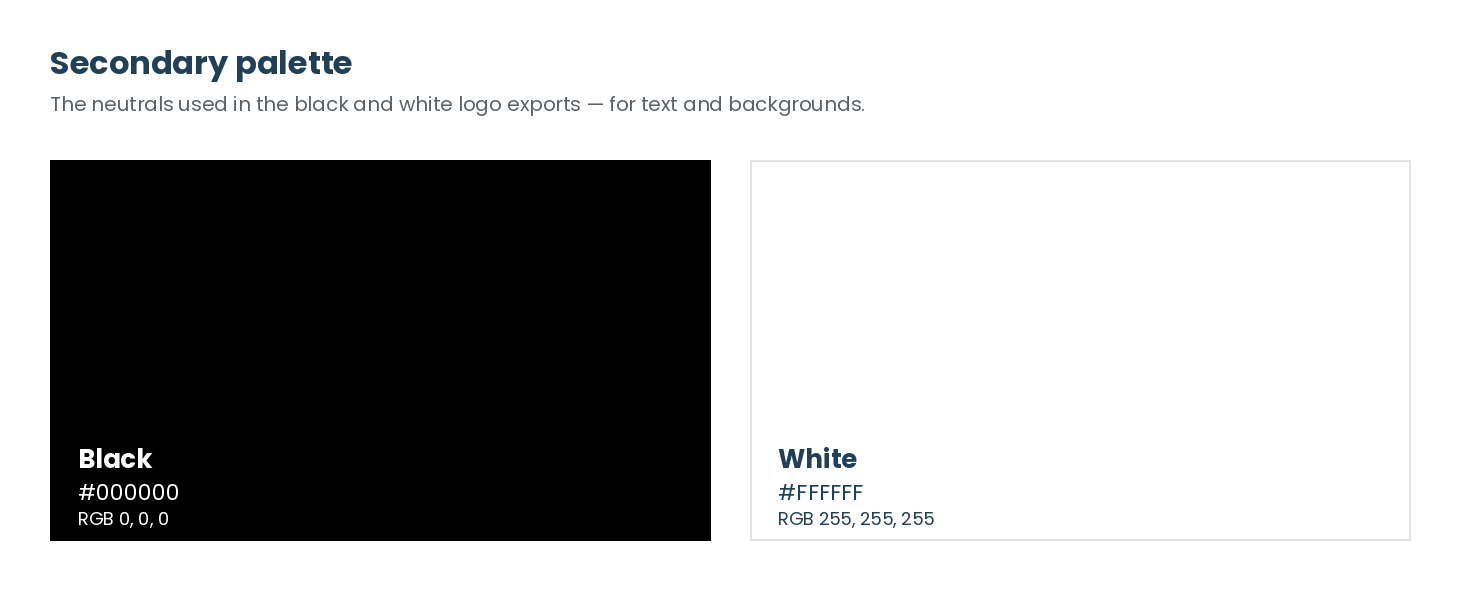
Black and white come directly from the logo’s own black and white exports, and do the plain work: text and backgrounds, wherever the primary palette isn’t the point.
Typography
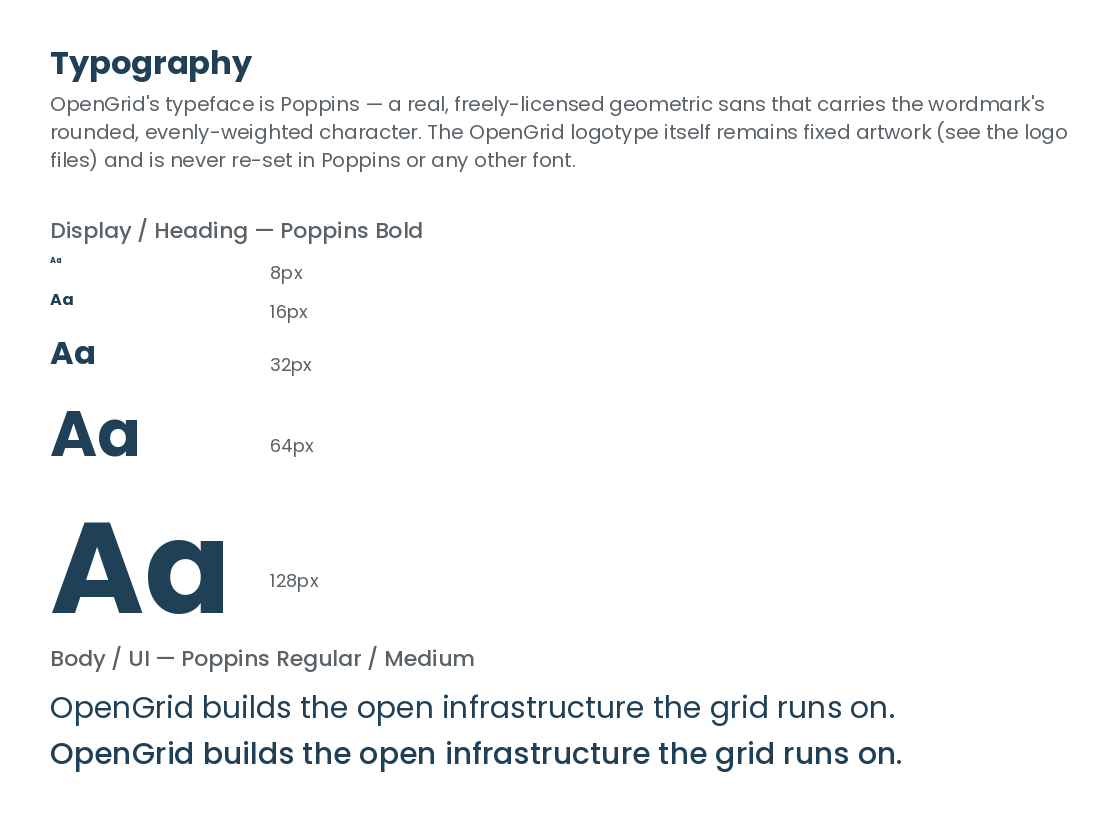
OpenGrid’s typeface is Poppins — a real, freely licensed geometric sans that carries the same rounded, evenly-weighted character as the wordmark. Use it for everything set in type: headings in Bold, body copy in Regular or Medium. The one thing that stays untouched is the logotype itself, which is fixed artwork and never reset in Poppins or any other font.
Legal
By using OpenGrid brand materials you agree to the Linux Foundation Terms of Use, the Trademark Usage Guidelines, these OpenGrid branding guidelines, and all OpenGrid rules and policies as may be updated from time to time. You also acknowledge that OpenGrid is the sole owner of OpenGrid trademarks, promise not to interfere with OpenGrid’s rights in them, and acknowledge that goodwill derived from their use accrues only to OpenGrid. OpenGrid may review use of the branding materials at any time and reserves the right to terminate or modify any use.
In general
For those using OpenGrid brand materials on a site external to OpenGrid, please don’t use our name, logos, or screenshots (“brand materials”) in ways that may be confusing, misleading, or suggest our sponsorship, endorsement, or affiliation. For example, your name and logo should be more prominent than the OpenGrid name or logo. And please don’t edit or change the OpenGrid logo — we like it how it is!
Advertising, promotional, and sales materials
Please check in with us before using our logo on websites, products, packaging, manuals, or for other commercial or product use. It’s ok to say in text “Member of OpenGrid” or “OpenGrid Member” (as long as it’s true!)
Education and instruction (books, guides, publications, and conferences)
You can use our brand materials for educational and instructional purposes but please remember that it shouldn’t be confusing, misleading, or suggest our sponsorship. For example, we generally don’t allow use of our logos or screenshots on book covers.
Also remember to include this statement (or something like it) in your printed materials: “[Title] is not affiliated with or otherwise sponsored by OpenGrid.”
Products, websites, names, and logos
Please don’t use our name as a part of your company or service name, website name, trade name, or product name. Don’t use our logo or incorporate our logo into yours. Don’t use a domain name containing “OpenGrid” or any confusingly similar words.
Linking to OpenGrid
If you want to promote your organization’s affiliation with OpenGrid you can use our logo if it meets our guidelines. For example, “[Company Name] is a member of [linked logo].”
Merchandise
While we do produce lots of t-shirts for our events that have our logo on them, we don’t generally allow third parties to make, sell, or give away anything with our name or logo on it.
Attribution
Please include appropriate attribution of OpenGrid’s ownership of its trademarks when you use them. This attribution notice can be included in the fine print at the bottom of your content. An example is, “OpenGrid and the OpenGrid logo design are registered trademarks of the Linux Foundation.”
More questions?
Feel free to email questions to marketing@opengrid.org. It helps if you send a mockup of your intended use so we can be specific in our response. We’ll do our best to get back to you ASAP but please give us two weeks (please note that no response doesn’t mean approval.) We’re currently only able to respond to inquiries made in English.
